
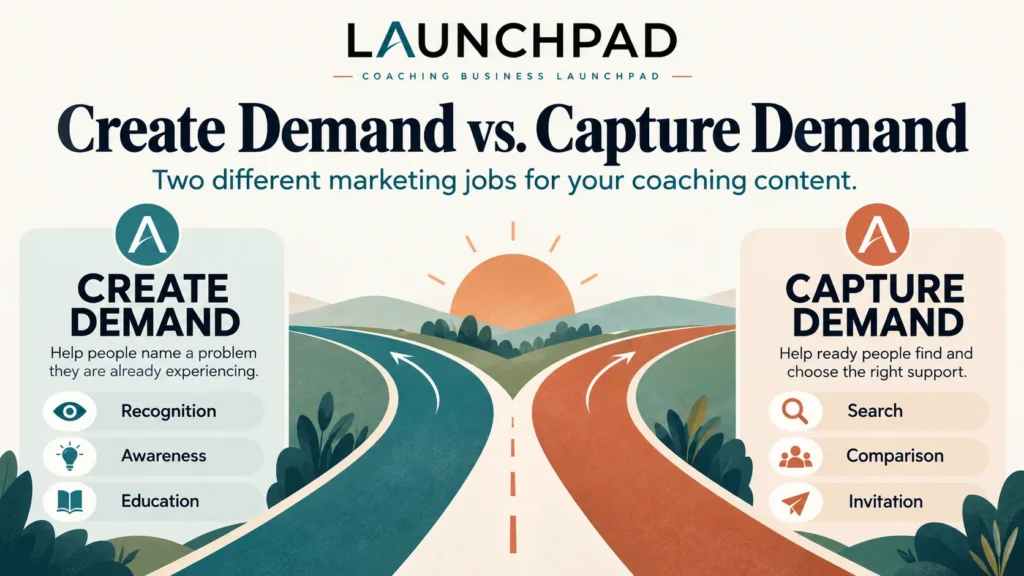
Not every potential coaching client is ready to search for a coach.
Some people know that something needs to change.
They are listening to podcasts, comparing programs, asking for referrals, searching online, and scheduling introductory calls.
Others are experiencing the early signs of a problem but have not yet named it.
They may notice that they are more irritable, less motivated, physically depleted, disconnected from their work, or uncertain about who they are becoming.
But they are not searching for coaching.
They may not even believe they have a problem that coaching could address.
Those two audiences require different kinds of marketing.
During Week 2 of Coaching Business Launchpad, we described this as the difference between capturing demand and creating demand.
Capturing Demand Means Meeting an Existing Search
Demand already exists when someone recognizes a need and begins looking for an answer.
They may search:
“Executive coach near me.”
“Career coach for a leadership transition.”
“How to manage burnout.”
“Support after becoming a new manager.”
“Coach for starting a wellness business.”
They have raised their hand, even if they have not contacted you yet.
Capturing demand involves making it easier for that person to find, understand, and trust your offer.
That might include:
- A clear service page
- Search-friendly articles
- Referral relationships
- A workshop
- A directory listing
- A consult invitation
- Messaging that clearly names the problem and outcome
The person already knows enough to search.
Your job is to help them recognize whether your approach fits.
Creating Demand Begins With Recognition
Creating demand does not mean manufacturing insecurity or convincing someone that they are broken.
Ethical demand creation helps people recognize an experience they are already having.
It may help them connect several symptoms that previously felt unrelated.
It may give language to something they could feel but could not explain.
It may show them that a situation they have normalized is not the only way forward.
Awareness content might say:
You may think you have lost motivation, but you may actually be carrying more responsibility than your current systems can support.
You may think you need better time management, but the deeper issue may be that your priorities have changed and your commitments have not.
You may think you are simply tired, but your body may be signaling that your current pace is no longer sustainable.
The person is not yet comparing coaches.
They are asking:
Is this what is happening to me?
That is an earlier stage of the relationship.
Awareness Is Not the Same as Readiness
One of the most useful insights from the session was that awareness alone is not always enough.
A person can understand the problem and still be unable or unwilling to act.
They may be short on time.
They may be caring for other people.
They may not believe change is possible.
They may have conflicting priorities.
They may not have the financial or emotional capacity to begin.
They may know exactly what they “should” do and still feel unable to do it.
That distinction matters.
The person may need awareness, but they may also need hope, permission, trust, support, or a smaller first step.
Your ideal coaching client archetype should help you understand not only whether the problem exists, but where the person is in relation to it.
Create Content for More Than One Stage
A useful content strategy does not assume every reader is ready for the same invitation.
You can create content for at least three stages.
Stage 1: Recognition
The person has not fully named the issue.
Your content helps them identify:
- A recurring pattern
- A meaningful symptom
- A costly tradeoff
- A transition they may be underestimating
- A disconnect between their current and desired experience
The goal is not an immediate sale.
The goal is recognition.
Stage 2: Understanding
The person knows something needs attention and wants to understand it.
Your content can explore:
- Why the pattern happens
- What commonly keeps it in place
- What people often try
- What may be missing
- What a healthier or more sustainable alternative could look like
This is where deeper blogs, videos, workshops, and conversations can build trust.
Stage 3: Action
The person is ready to consider support.
Now they need clarity about:
- Who you help
- What you help them address
- What working together looks like
- Why your approach may fit
- What they should do next
This is where a direct offer or application becomes appropriate.
You can also learn how to create coaching content from real client conversations rather than guessing which stage your audience is in.
Do Not Force Every Post to Sell
Not every piece of content needs to conclude with:
Book a call now.
Some content creates recognition.
Some deepens understanding.
Some builds trust.
Some invites action.
The problem is not that coaches create educational content.
The problem is when they create educational content indefinitely without establishing a clear way for a ready person to work with them.
You need both sides.
Awareness for the person who has not named the problem.
A clear invitation for the person who is ready.
Ask Which Demand You Are Addressing
Before creating your next message, ask:
Is this person already looking for support?
Or am I helping them recognize why support might matter?
If they are already searching, make the solution clear.
If they are still making sense of the experience, meet them there.
Marketing becomes more human when we stop treating everyone as if they are at the same stage.
The next Coaching Business Launchpad cohort begins October 20th. Explore the program and apply to build a visibility rhythm grounded in how your audience actually thinks, searches, and decides.